1. Product Description
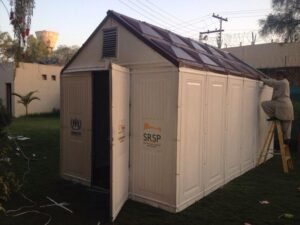
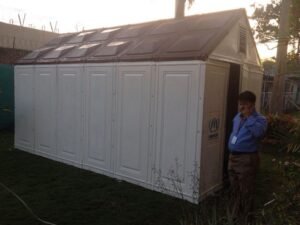
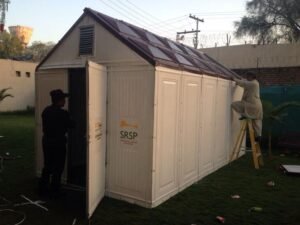
The Emergency Housing Unit (EHU) is a prefabricated, portable shelter designed to provide reliable accommodation in emergency situations, disaster-relief operations, temporary residential settings, and remote working environments.
Engineered using Fiberglass Reinforced Plastic (FRP/GRP) panels and a high-strength aluminum alloy framework, the EHU combines structural durability, lightweight construction, portability, and ease of installation.
2. Technical Specifications
Specification | Details |
|---|---|
Overall Dimensions | 17 ft × 9 ft × 10 ft (5.18 m × 2.74 m × 3.05 m) |
Length | 17 ft (5.18 m) |
Width | 9 ft (2.74 m) |
Overall Height | 10 ft (3.05 m) |
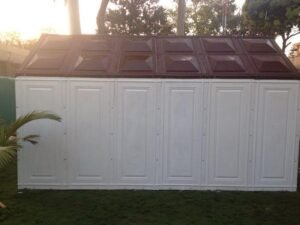
Lengthwise Wall Panels | 12 |
Widthwise Wall Panels | 6 |
Roof Panels | 12 |
Total Main Panels | 30 |
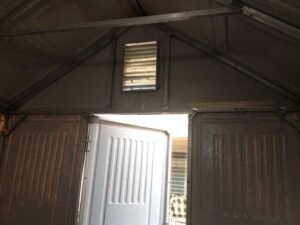
Triangular Panels | 4, including 2 louvers (front and rear) |
Total Panels | 34 |
Covered Area | 153 sq. ft. |
Total Surface Area | 581 sq. ft. |
3. Construction Materials
Component | Material |
|---|---|
Wall and Roof Panels | Fiberglass Reinforced Plastic (FRP/GRP) |
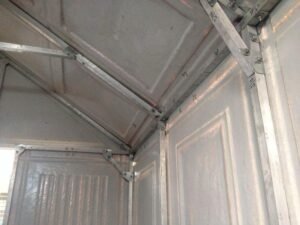
Supporting Framework | Extruded aluminum alloy square tubing, 1.25″ × 1.25″, 18 SWG |
Clamps | Die-molded Galvanized Iron (GI) |
Fasteners | Galvanized Iron (GI), with additional rubber washers on external panels |
Entrance Door | FRP/GRP, 7 ft × 3 ft |
Door Support | Aluminum tubing |
Door Hinges and Fasteners | Galvanized Iron (GI) |
Locking Mechanism | Aluminum door lock |
Door Handles | Two handles (internal and external) |
4. Product Overview
The Emergency Housing Unit (EHU) is an innovative, lightweight, and durable prefabricated shelter developed to meet the demands of emergency accommodation and temporary housing.
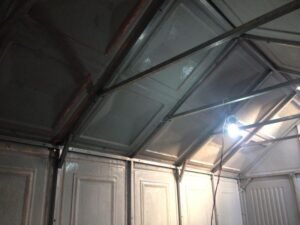
Its construction incorporates modern engineering materials, including Glass Reinforced Plastic (GRP), commonly known as fiberglass, and high-strength extruded aluminum alloy tubing. This combination provides a practical balance of structural strength, corrosion resistance, reduced weight, and long-term durability.
Unlike conventional welded structures, the EHU features a modular, non-welded assembly system that simplifies transportation, installation, dismantling, and relocation. The unit can be assembled on-site using commonly available tools, without requiring specialized installation expertise.
Its lightweight components can be handled by a small team of two to three people, reducing reliance on heavy lifting equipment and specialized transportation arrangements.
5. Key Features of the Aluminum Framework
The EHU uses an extruded aluminum alloy framework instead of conventional timber or heavy carbon-steel structures. This provides several functional and structural advantages:
Precision-engineered construction: Extruded aluminum tubing offers consistent wall thickness and uniform material properties.
Optimized structural design: The 1.25″ × 1.25″, 18 SWG square tubing is selected to balance strength, structural stability, and weight.
Lightweight composition: Aluminum has a specific gravity of approximately 2.7, compared with approximately 7.6–7.8 for steel, making it significantly lighter.
Load-bearing reinforcement: Structural trusses and supporting members are designed to distribute loads across the framework.
Additional bracing: Reinforcement is incorporated where necessary to improve overall structural stability.
Corrosion resistance: Aluminum offers good resistance to environmental corrosion, supporting a longer service life.
Reduced thermal conductivity compared with steel: Aluminum conducts heat less readily than carbon steel, although it remains a conductive material.
Non-welded assembly: Mechanical connections allow convenient on-site installation and dismantling.
Optional surface treatments: Heat treatment, anodizing, and coloring may be provided according to project requirements.
6. Key Features of FRP/GRP Panels
Fiberglass Reinforced Plastic (FRP/GRP) is a versatile composite material recognized for its strength-to-weight ratio, corrosion resistance, and suitability for demanding environmental applications.
The EHU’s FRP/GRP panels offer the following advantages:
Smooth, glossy external finish with protective internal coating.
Resistance to weather exposure, including rain and varying climatic conditions.
UV-stabilized construction to reduce degradation caused by sunlight.
Excellent corrosion resistance compared with many conventional metallic materials.
High strength-to-weight ratio, reducing overall structural weight.
Lightweight composition, with an approximate specific gravity of 1.8 compared with 7.6–7.8 for steel.
Convenient drilling, handling, installation, and component replacement.
Capability for localized repairs without dismantling the entire shelter.
Electrical insulation properties and comparatively low thermal conductivity.
A projected minimum service life of 10 years under suitable operating and maintenance conditions.
Availability in customized colors and finishes to meet project requirements.
7. Key Features of Galvanized Iron Clamps
The EHU incorporates die-molded galvanized iron clamps to provide secure and reliable connections between structural components.
Key advantages include:
High-strength molded construction for dependable structural connections.
Simple handling and installation.
Durable construction suitable for repeated assembly.
Protective galvanized coating for improved corrosion resistance.
Minimal maintenance and no routine painting requirements.
Pre-marked components to simplify identification and installation.
8. Key Features of Fasteners
The fastening system is designed to support structural stability while allowing convenient assembly and disassembly.
Galvanized bolts and nuts are supplied with double-washer arrangements.
Galvanized coatings help protect components against corrosion.
Standard fastening components can be sourced from local hardware suppliers when replacements are required.
Rubber washers are incorporated at external panel connections to improve sealing and minimize water ingress.
Installation requires commonly available hand tools, including spanners and wrenches.
9. Mild Steel Base Plates and Anchoring System
The EHU is equipped with a base anchoring system designed to improve structural stability and secure the shelter to suitable ground conditions.
The system includes:
Ten mild steel (MS) base plates with anchoring pins.
High-strength steel components designed to support structural loads.
Ground anchoring provisions intended to improve resistance to movement and wind-induced forces.
Compatibility with suitable grouting and anchoring arrangements, depending on installation conditions.
The anchoring system helps maintain the shelter’s position and structural stability, particularly in exposed or uneven environments.
10. Comparison: EHU vs. Conventional Fabric Tent
Characteristic | EHU (Aluminum + GRP) | Conventional Fabric Tent |
|---|---|---|
Service Life | Designed for a minimum of 10 years | Approximately 6 months, as stated in the original comparison |
Warranty | 3-year manufacturing-defect warranty | Varies by supplier |
Weather Resistance | Designed for improved protection against rain, heat, and wind | Protection depends on fabric quality, design, and anchoring |
Appearance | Smooth, glossy finish with a structured design | Flexible fabric-based appearance |
Structural Durability | Rigid construction with greater capacity for supporting suitable loads | Limited structural load-bearing capability |
Door Security | Solid entrance door with integrated locking mechanism | Usually relies on zippers or lightweight closures |
Portability | Modular bolted system supports repeated assembly and relocation | Lightweight and portable, but repeated handling may cause wear |
Cost Effectiveness | Higher initial investment with potential long-term value | Lower initial investment but may require more frequent replacement |
Manufacturing | Suitable for standardized production and consistent component quality | Manufacturing processes vary by tent type |
Accommodation | Designed to accommodate approximately 8–10 people, subject to layout and applicable occupancy requirements | Capacity varies; the original comparison specifies 3–5 people |
Ventilation | Front and rear louvers support cross-ventilation | Depends on tent openings and ventilation design |
Additional Applications | Temporary accommodation, site offices, security posts, and field facilities | Primarily temporary accommodation and outdoor shelter |
11. Conclusion
The Emergency Housing Unit (EHU) offers a practical and durable alternative to conventional temporary shelters. Its combination of lightweight aluminum framing, FRP/GRP panels, modular assembly, and corrosion-resistant components makes it suitable for emergency response, temporary accommodation, construction sites, and remote operations.
Designed with portability, structural reliability, and ease of maintenance in mind, the EHU provides a flexible shelter solution for organizations seeking dependable prefabricated accommodation.